INSIGHT · TELECOM & MARKETS
Telekom (OTE) is putting €600M+ into fibre and 5G in 2026. Starlink is gaining ground in Greece with no network of its own
Telekom (OTE) announced a 2026 capex target above €600M, with FTTH expansion and 5G standalone named as priorities. Over the same period, press reporting shows Starlink gaining ground in fixed internet access without having invested in any network inside the country. This piece puts the two facts side by side, without claiming certainties the sources don't give.
1. The capex target is announced, the breakdown isn't
On 31/10/2026 Telekom reported a 2026 capex target "slightly above €600M," with FTTH network expansion and 5G standalone named as priorities (ot.gr, 31/10/2026). The announcement gives no category breakdown: we don't know how much of that goes to fibre, how much to 5G, and how much to other network lines. The €600M+ is the company's total target for the year, not a line item set aside "for fibre and 5G."
If Telekom published the category breakdown, would the picture change?
2. The competitor that isn't building a network here
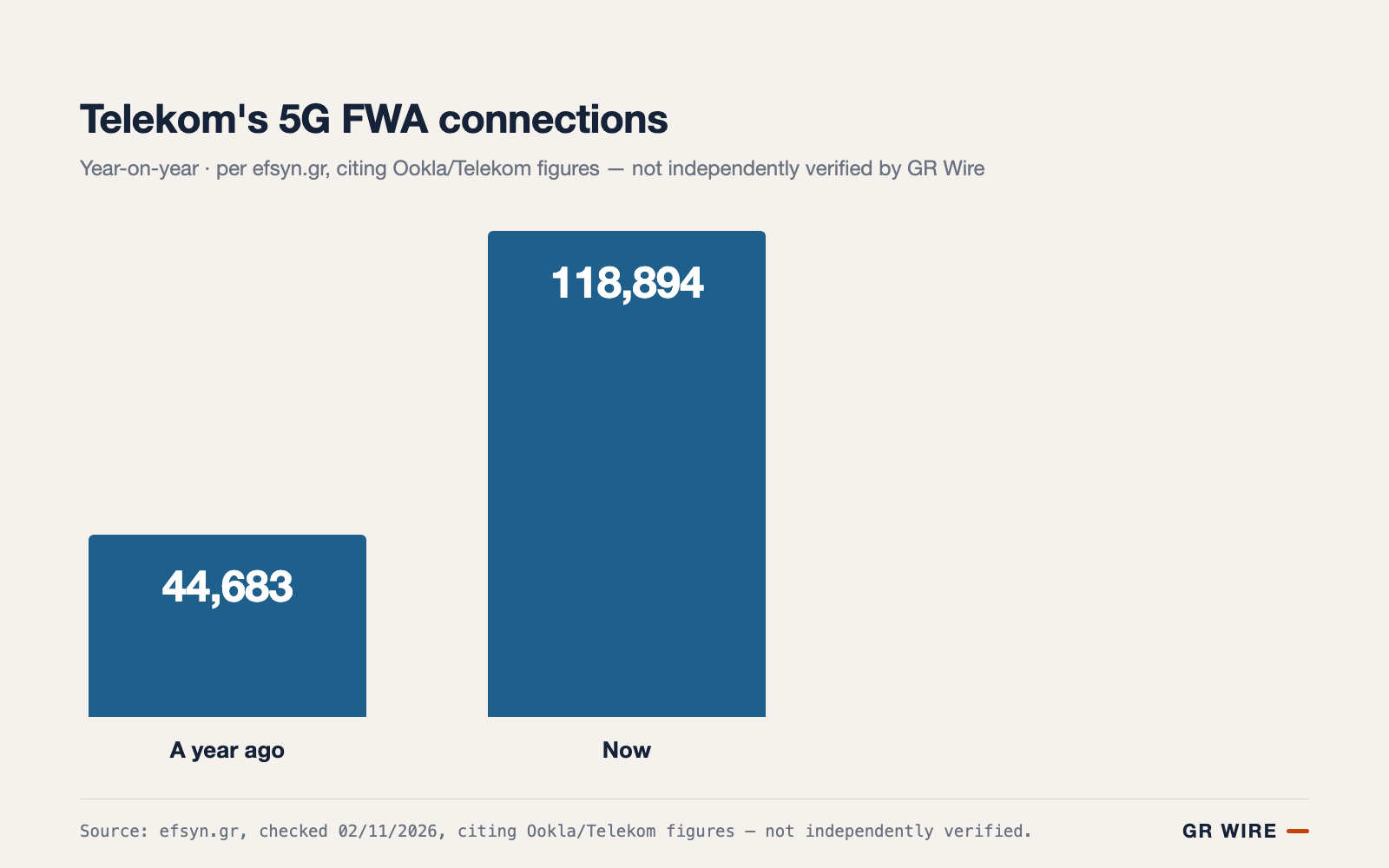
Per a report in Efimerida ton Syntakton (efsyn.gr, checked 02/11/2026), which cites Ookla figures, Starlink accounted for about 6% of fixed-broadband speed-test measurements in Greece in Q1 2026. The same report states that Telekom's 5G FWA connections grew year-on-year from 44,683 to 118,894. We did not verify either number directly with Ookla or with a Telekom disclosure, so we attribute them to the outlet that published them rather than to our own verification.
If a competitor is gaining share with no network on the ground, what does that mean for what operators are investing in theirs?
3. The adoption gap doesn't close on capex alone
Whether Telekom's €600M+ reaches the household is a separate question from whether it reaches the network first. In our own Insight #2 we showed that fibre is now priced about the same as VDSL at several operators, yet only about one in three homes that can already get fibre have taken it (GR Wire, EETT data through end-June 2026). Price, in other words, no longer looks like the barrier; something else is holding back adoption inside homes that already have coverage.
Does new network investment help, if the obstacle sits somewhere else?
4. What "winning" here would even mean
We have no figure for Starlink's eventual share of the Greek fixed-access market, and the source itself gives no confirmed subscriber count, only market estimates. What we can say from the above is that fixed operators are investing in network at the same moment a competitor with no local network is gaining ground, and adoption on the network that already exists is lagging. If the price gap has closed, as we showed in Insight #2, and adoption still sits at one in three, the question isn't only how much network gets built, but how fast it fills up.
Where would you put the next €600M: into more network, or into something else?
Sources
- ot.gr, "Telekom: investments above €600 million for FTTH and 5G in 2026," 31/10/2026.
- Efimerida ton Syntakton (efsyn.gr), "'Space' is the new clash over the internet in Greece: Elon Musk's Starlink is gaining ground," checked 02/11/2026.
- GR Wire, Insight #2, "Fibre costs about the same as VDSL. About one in three homes that can get it have it," checked 25/10/2026.
Method: the figures on Telekom's capex programme and on fibre price/adoption come from the primary sources listed. The Starlink/Ookla figures and the growth in Telekom's 5G FWA connections are secondhand, from the efsyn.gr report, and have not been verified directly with Ookla or Telekom. GR Wire does not publish its own market-share figure for Starlink.