INSIGHT · TELECOM & FIBRE · Series: Fibre in Greece, in three questions (2/3)
Fibre costs about the same as VDSL. About one in three homes that can get it have it
The fibre networks keep growing and, at several operators, a fibre plan is now priced close to VDSL or below it.
Take-up is rising too, but more slowly than the networks. This piece looks at that gap and at the reasons it might have, without claiming to know which one matters most.
1. The networks are there
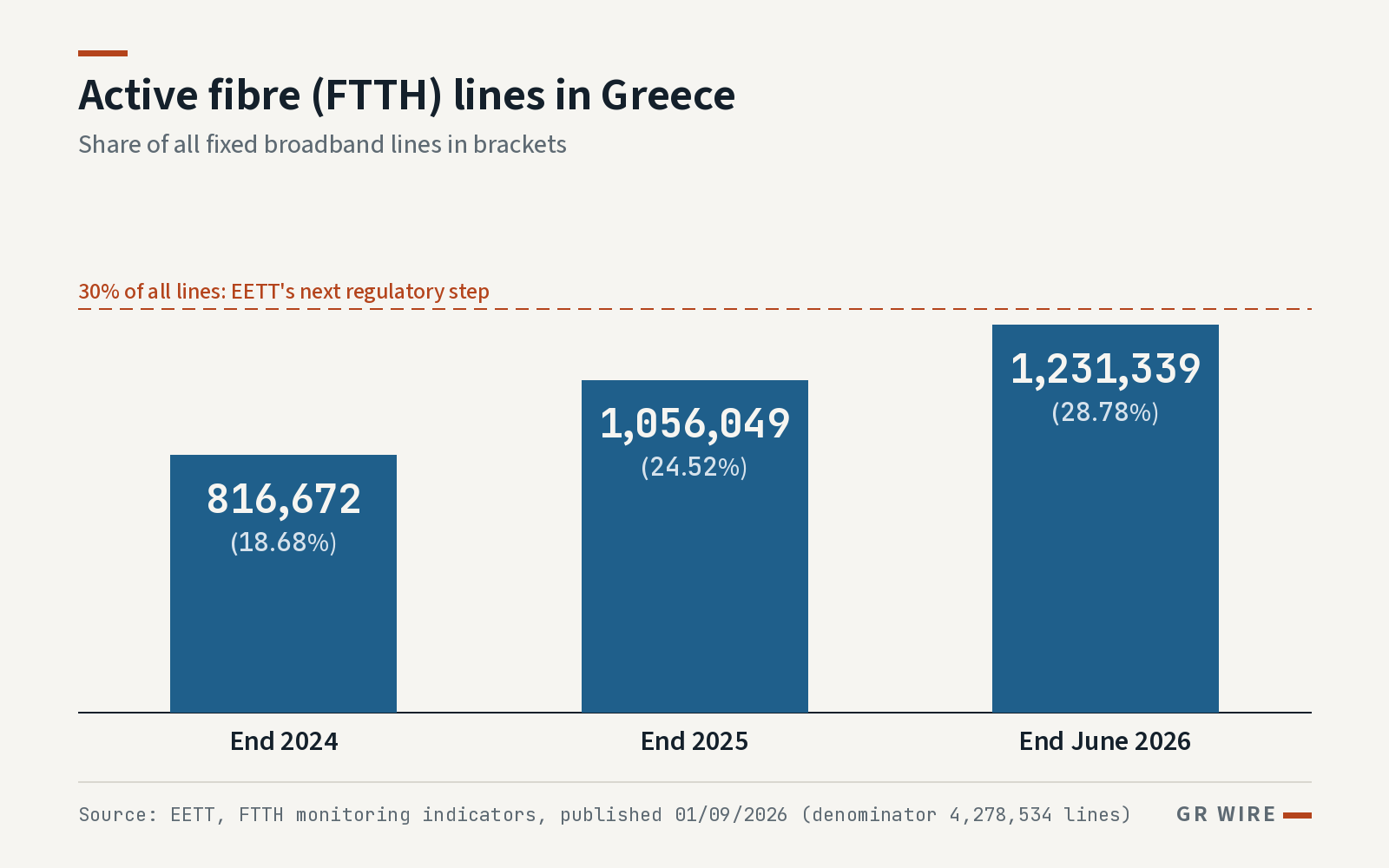
At the end of June 2026 Greece had 1,231,339 active FTTH lines out of 4,278,534 fixed broadband lines, or 28.78% (EETT, published 01/09/2026). Eighteen months earlier, at the end of 2024, there were 816,672 (18.68%). At the end of 2025 there were 1,056,049 (24.52%). EETT links crossing 30% to its next regulatory step.
The build-out has gone faster than that. OTE reports 2,221,289 fibre homes passed in Q2 2026, up from 1,874,548 (OTE results, 29/07/2026). DEI FiberGrid reports 2.3 million homes passed, of which more than 1.5 million are ready for service (Capital, 17/10/2026). Nova's CTO put fibre availability close to 70% (Advanced Telecoms Summit, 29/09/2026, via Euro2day).
Where you live or work, is fibre already at the door?
2. The price is no longer the barrier it was
On 24-month contracts, checked on 25/10/2026:
| Plan | Vodafone (with TV Start) | Nova | Telekom |
|---|---|---|---|
| VDSL 50 | €26.10 | – | – |
| Fibre 100 | €23.80 | €21 | – |
| Fibre 300 | €27.10 | €23 | €24.90 |
| Fibre 1 Gbps | €30.35 | €31 | €33.90 |
In Vodafone's list, fibre 100 is priced below VDSL 50, and fibre 300 is €1 above it. Vodafone's fibre prices are offer prices for 12 months and can then rise by up to €3. An earlier Telekom price list (February 2026) had VDSL 50 at €22.90 and VDSL 100 at €24.90, the same as Telekom fibre 300 today. That list may have changed since.
So for many households the monthly cost of moving from VDSL to fibre is small, or zero.
When did you last compare what you pay with what fibre would cost?
3. About one in three
Comparing EETT's active lines at the end of June 2026 with the operators' homes-passed figures, about one in three homes that can get fibre have taken it (GR Wire calculation). The operators' own figures point the same way. Nova's CTO gave adoption at 30–32% against availability close to 70% (29/09/2026). OTE reports 686,831 fibre customers, up from 470,368 (+46%). It also says 54% of OTE customers who can get fibre have taken it (29/07/2026). That second figure covers OTE's existing customers only, which is why it is higher.
Buildings tell a similar story. Of 1,439,658 buildings passed, 649,698 (45.1%) have at least one active fibre line. A building covered by more than one network is counted once per network (EETT, end-June 2026).
Does one in three match what you see in your street or your building?
4. Why? Some possible reasons
There is no single measured answer. These are possibilities, not findings:
- Inside the building. Fibre "at the door" is not always fibre in the flat. Wiring through a shared staircase or riser can need agreement among neighbours, a site visit and an appointment.
- Not knowing the price has moved. Many people chose their plan when fibre was clearly more expensive. If the comparison is not repeated, the old picture stays.
- The effort of switching. A running 24-month contract, a technician visit, a day at home, a new router. Each step is small. Together they are a reason to wait.
- "What I have works." At the end of 2025, VDSL was still the largest technology at 46.2% of lines. 46.3% of all lines were already at 100 Mbps or more (EETT broadband report, end-2025 data, posted August 2026). For a household happy with VDSL, the difference may not be obvious.
Probably several of these apply at once, and in different proportions in a city flat, a village house or a small office.
If you could get fibre and haven't switched, what is the main reason?
5. Next: is the speed actually felt?
nPerf measured an average fixed download speed of 115.89 Mbps in Q3 2026, against 95.2 Mbps for the whole of 2025. The periods differ, so the comparison is indicative (via InfoCom.gr, 20/10/2026). Part 3 of the series asks whether people feel that in daily use: how much depends on the router, the Wi-Fi in the home and the plan tier, and how much on the line itself.
After moving to fibre, did you notice the difference, and where?
Sources
- EETT, FTTH services monitoring indicators (end-June 2026 data), published 01/09/2026.
- OTE Group, Q2 2026 results, 29/07/2026.
- Euro2day, "Optical fibers: the race of networks and the target", Advanced Telecoms Summit, 29/09/2026.
- Capital.gr, fibre active connections and competition, 17/10/2026.
- Vodafone Greece, fibre-to-the-home plans, checked 25/10/2026.
- Nova, fixed internet plans, checked 25/10/2026.
- Telekom (OTE), fibre plans checked 25/10/2026; VDSL prices from the February 2026 price list.
- EETT, broadband report (end-2025 data), posted August 2026.
- nPerf, via InfoCom.gr, 20/10/2026.
Method: figures as reported by the sources above. "About one in three" is a GR Wire calculation from EETT active lines and operator homes-passed figures; operators count homes passed differently and networks overlap, so it is an approximation. GR Wire did not run its own survey.